

Creating Conditions for Thawing
Invitation into the living-work of change.

Last week, the Ohio River, at the shores of Cincinnati and Covington, KY froze over.
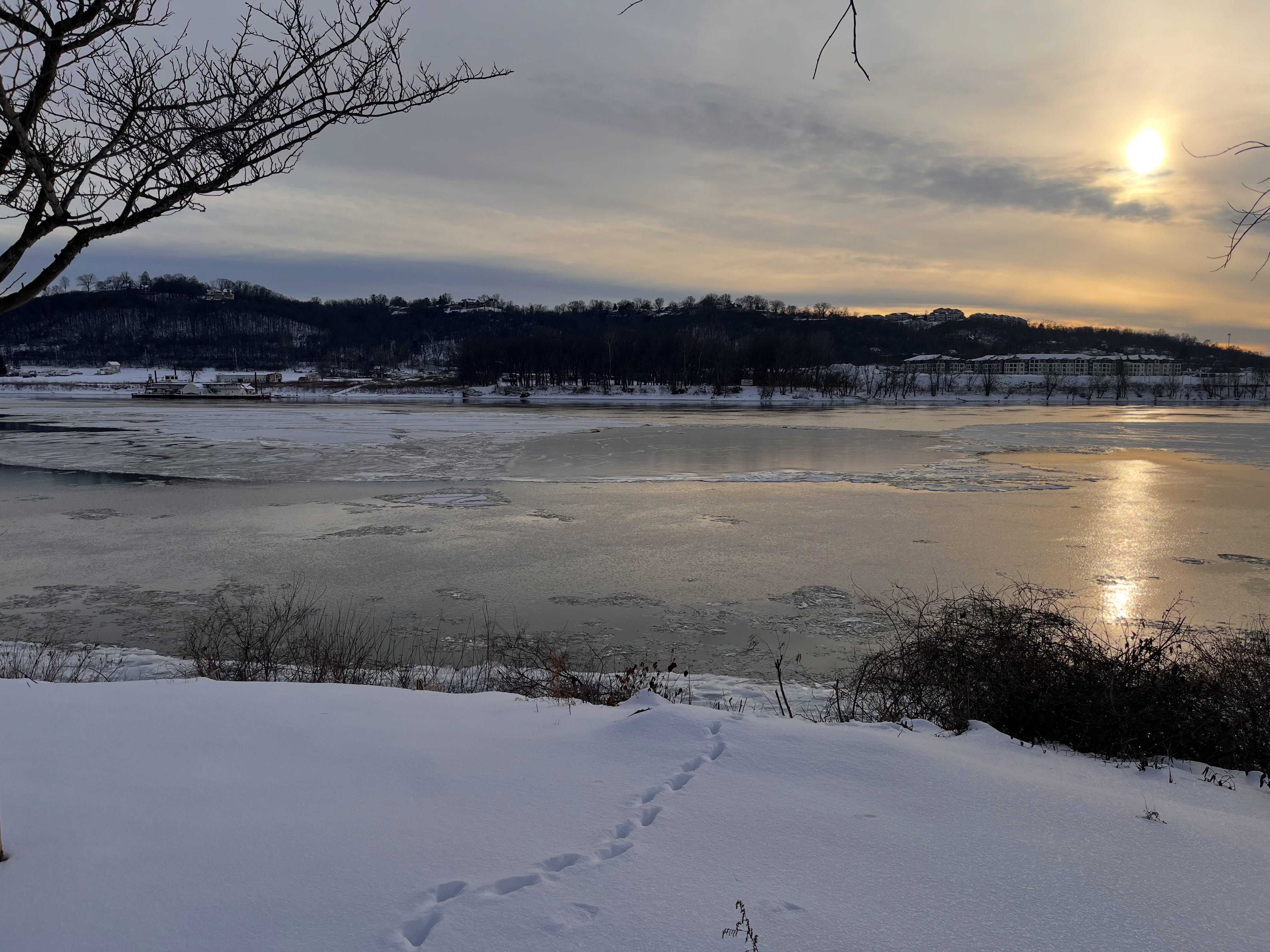
What once looked rippled (and often green-brown) now is gray and slick, at times reflecting the sun and moon, other times dampened with the matte finished new snowfall. Where I often stand to see otters, mallards, coot, largemouth bass or channel fish, now looks more like an abandoned desert or parking lot. Even without scientific instruments or a google search your body can still tell, something must be going on underneath. But when will it reemerge?
(And just imagine, over the long stretch of time, how many times rivers completely iced, only to be moved or redrawn centuries later by glaciers and tectonic oceanic shifts. The scale is perennial.)
So many things around us today are in a frozen state—long or short winter or slow approaching ice-age, is not ours to know. Punxsutawney Phil be damned! The Ohio will thaw again, and the life that feels hidden or submerged will return to our senses.1
When was the last time you walked into a room or a conversation that returned you to your senses? Not quick-firing complaint or worry, but one where your own sense of being who you are thaws into the flow, and you feel like the moment is larger than just the combination of good individuals? Maybe it was a pot luck or a concert. Maybe a chance meeting at a coffee shop or bar. Maybe it was before or after a meeting, or a religious service, or a kid’s basketball game. Maybe it was smack dab in the middle of such a happening!
I was in an ICE preparedness training last weekend and surprised by that same sort of resonance and connection. Mutuality, listening, laughter, song, reaching for my wife’s hand with tears, clear commitments being made, phone numbers exchanged—even in high stakes planning we were thawing out together.
Practicing Together
These occasions of co-regulation appear to the untrained eye as happy accidents. And you’ve probably notice that the ingredients can feel consistent: openness, self awareness, courage, and curiosity—to name a few.
And just as Jim Finley says about personal contemplative practices, group and team practices are shared acts of fidelity with the thawing moments of belonging you’ve already experiences— “practice is the act of creating the conditions to be more accident prone.”
Information flooding, witnessing pain without ways to discharge, gnawing anxiety turning to doubt, despair, and biting back are everywhere we turn. Without community and shared community intentions, life’s tyranny internalizes, eroding the capacity of already-weary families, teams, groups, and organizations.
Unburdening Systems
Our nervous systems are flooded with urgent reactions and overwhelmed by responsibilities, spoken or unspoken. And parts of us can confuse these as insurmountable burdens to placate, hungry mouths to feed first, before we can even claw back space to be present or feel like we’re living on purpose. We play by an unexamined inner soundtrack of “ Working of the weekend”. We resort to unconscious personality ticks and tricks to either keep this second’s most urgent thing front and center, or to bypass the underlying fears, criticisms, and cynicism.
Like nervous systems, social systems can flood as well. And urgencies and bypassed conflicts in our families, relationships, and workplaces freeze our natural interdependence.
We’re frozen just when the time for change is called for.
What I’ve Learned About Change
(and How I Could Walk With You)
In twenty-five years of working with small groups, contemplative practice, and communities engaged in change, I’ve had the privilege of learning alongside people in very different contexts: international peacekeepers, organizers, inter-spiritual healers, emerging systems leaders, contemplative Christians, artists, pastors, and executives.
What surprised me in 2025 is how much all of these experience began to feel like a single practice.
This past year I facilitated mediation with families who have been in conflict over a shared business for decades. I worked with congregational leaders in intractable disagreement. I supported both national climate leaders, and community associations who realized that technical strategy alone wasn’t enough—they needed stronger relational fabric between them. I worked with churches that have become safe harbor for people recovering from spiritual abuse. I coached women answering the long desire to integrate their vocational gifts and personal longing. I coached men uncovering grief and pain that had never been named.
Different settings. Similar patterns.
What I keep seeing is this:
Our brokenness, longing and imperfections do not have to be stopping points.
Groups are not doomed to repeat their freezing habits.
Stymied systems do not need more surface-level technical change, but internal processes for growing more aware of one another, and flowing together.
But many people are overstimulated, under-witnessed, and living inside patterns that once protected them and no longer serve life.
We tend to respond to this by reaching for more strategy, more urgency, more effort. And sometimes what’s actually needed is something simpler—but harder to prioritize:
To slow down enough to notice what’s happening inside us.
To strengthen our capacity to stay present with discomfort.
To rebuild trust in our own inner authority.
To practice being with one another in ways that make wiser action possible.
Coaching, team building, retreats, spiritual direction—I don’t experience my work primarily as fixing problems. In the contemplative tradition this work is more about cultivating practices that create conditions for our hidden connections to re-emerge. In organizational behavior and coaching this is described as belonging with intention:
Brave Conditions where people can remember who they are.
Conscious Conditions where reaction becomes information instead of collapsing to, bypassing around, or coercing others.
Conditions and routine check-ins where wisdom has a chance to surface.

Over time, I’ve come to see three distinctions that quietly serve personal and team thawing:
1) We don’t manufacture transformation. We create conditions for it.
In contemplative traditions, there’s a simple but demanding insight: we cannot force union, clarity, or healing into existence.
What we can do is practice in ways that make us more available. Small, repeatable rhythms. Attention to breath and body. Gentle curiosity toward our inner life. Spaces where nothing has to be performed.
Over lunch one day with my colleague and friend, Adam Fronczek, I came upon the similarities between this work and something most are familiar with: physical therapy.
Physical therapy usually isn’t complicated. It’s not ambiguous. The movements are often simple. The challenge is not difficulty. The challenge is prioritization and repetition.
Over time, those small movements restore range of motion. They rebuild underdeveloped muscles. They change how the whole person’s body moves through the world.
Interpersonal Team Development is like PT for the coordinated tension loads between group members.
Groups and organizations can develop repetitive-motion injuries: ways of meeting, decision-making, and reactions that slowly exhaust the team. They keep playing “tennis” the same way, even though something in the joint is wearing down.
Practice doesn’t mean adding cumbersome techniques to our meetings or ways of interacting. It means intentionally becoming aware of stress in the system and skillfully moving through it together—removing habits that rely on postures, rigidity, or passive aggressive coercion.
Practice makes wiser action possible.
2) Freedom is not the absence of structure. It is the capacity to flow through reality with choice.
We often imagine freedom as “no constraints.” In my experience, freedom feels more like flow. You can’t go around conflict or limits, you go through them—with grace, collaboration, and courage.
A pin ball isn’t free because the pinball machine has no mechanisms. It’s free because it can move through the mechanisms. Conflict and obstacles are not threats to control, but context partners to dance with or through.
Boundaries, agreements, and structures don’t eliminate freedom. They give shape to it.
The real loss of freedom is pretending we are limitless. The real loss of freedom is being stuck inside unconscious patterns that bypass the fear of what we cannot control.
Much of my work—whether in coaching, mediation, or retreats—is about helping people notice:
What point of view am I reacting from?
What is my body signaling (e.g.: change in vocal tone, posture, breath, brain fog)?
What story am I telling? And what is that costing me or others?
What is my criticism or cynicism working so hard to protect?
Where do I still have choice? Where do I still have connection?
Why is this important to you, and what can we do together about it?
When reaction becomes something we can turn toward with compassion, it stops secretly running our lives. Our survival reactions, then, feel more like an intelligence that we can respect—a sort of “new information” that lead to more clarity and vulnerable courage to stay in the game with others, as opposed to taking us out of the game.
From there, movement and collaboration becomes possible again. In some instances compromise is all that is possible, but the trust to do so comes from establish habits of collaboration that values assertiveness and co-operation. Flow returns!
3) Wisdom is not something we acquire. It is something we learn to access together.
Many people assume they lack wisdom—that it’s some golden ring in a distant future that would finally relieve anxiety or justify a hard choice, if only we could reach it. Knowledge and experience can inform our decisions, but wisdom arises in the moment through openness, inner authority, resonance with others, and a healthy dose of humility.
What I see far more often is that people lack the conditions in which wisdom can surface:
Speed crowds out wisdom.
Fear drowns out wisdom.
Isolation freezes our capacity to follow wisdom.
When people are given time, safety, and simple structures for listening—to themselves and to one another—something different begins to happen.
Not perfect agreement.
Not collapsing to the most fearful experience in the room.
But a deeper sense of what matters to guide courageous choosing.
A clearer access to shared values and our inner moral compass.
A stronger social-fabric to stay in relationship through difference and conflict.
I think of this as building wisdom muscle.
And like any muscle, it grows through reps and consenting to expanding stress loads. Building resilience to go through, and not around.
Across all the different forms my work takes, I’m essentially doing the same thing:
Co-creating soft places to land in a hard time.
Helping people metabolize change rather than brace against it.
Strengthening inner and relational capacity so wiser action becomes possible.
Sometimes as a one-on-one coach. Sometimes in small groups. Sometimes in retreat spaces. Sometimes inside organizations and congregations.
This is something we already know, we’ve already experiences in one way or another. But I’ve found that accompaniment can deepen the learning experience. If creating the conditions for freedom and wisdom resonates with you, here are some of the ways we might work together, based on work I did in 2025:
Individual
IFS-informed coaching: clients experience turning toward the urgent/frozen parts of themselves with clarity, calm, and courage, and releasing these parts from the burdens they’ve taken on.
Executive Leadership coaching: integrating inner courage with relationships and structures that leaders have responsibility for.
Grief Work: Ross Gay explains grief as the metabolizing of change. Ambiguous losses, lost jobs, partnerships, and futures, even the change in holding roles at organizations who adapt to external changes can build up. Accompaniment helps metabolize and integrate such change.
Spiritual Direction: the long tradition of accompanying someone in witnessing their life as a sacred expression and holy arising—informed by the Christian contemplative tradition.
Couples
Four session premarital or marriage renewal coaching process to helps couples slow down, understand themselves and each other more deeply, and build practical skills for navigating change, conflict, intimacy, and commitment.
Wedding ceremony: the above process including designing a public expression of commitments (I am an ordained minister).
Retreats/Training
Organizational and staff retreats focused on belonging that comes from sharing brave space and deepening resilience for stressful situations.
Contemplative Christian Retreats for clergy to recover courage, clarity, and creativity in their leadership and inner life.
Equipping teams to discern the purpose, values, agreements, and meeting rhythms to balance change and belonging.
Teaching trauma-informed responses for those who care for the vulnerable.
Mediation
Family businesses in generational handoffs, seeking to forgive impasses, recover inner agency and rebuild shared agreements.
Staff conflicts that seem intractable left to their own devices.
If you’re navigating change, tending grief, sensing something new trying to be born, or simply longing for a place to breathe—you’re welcome to reach out. If you know someone in this space looking for retreats or personal coaching, please introduce us.
We can start with a conversation.
Thanks for reading to the end. What are your takes on unfreezing in this times?
If you coach, lead retreats, or have benefited from this sort of work and see ways to expand on any of this in the chat, please dive right in!
Hi Troy! You asked: “When was the last time you walked into a room or a conversation that returned you to your senses?” I had a meeting on Thursday with a coworker with whom I’ve been somewhat estranged. They’ve been away from work for a variety of personal reasons and for months I have felt really disconnected from this person with whom I’ve worked very closely in the past. Since they’ve returned, I haven’t done much to refresh or engage the relationship.
Our meeting was to plan a creative project, but I started by first asking, “So what’s going with you?” That triggered a response that was unexpected by both of us, and a real outpouring of honest sharing, about pain and struggles.
It was authentic and pure, and warm enough to thaw the ice that had built up, and reveal what was going on beneath the surface.
We didn’t plan our project (that got rescheduled) but we did reestablish our friendship and a healthier working relationship.
And I’ve found myself reflecting on the meeting over the last few days, with a real sense of peace, well-being.
Thank you, Troy! I resonate with your observation that wisdom flows in. While I come from a specific theological understanding of how that flow works, and perhaps you do too, my curiosity is asking how do I bring the reality that wisdom flows in to individuals and organizations which do not share my theological view? Of course, after years of practice, I can certainly sit with people who have a different theological view, and I can watch wisdom flow without overlaying my theological view. But I would appreciate a conversation about the optimal ways of sharing the precious realization that wisdom flows in with those who haven’t yet realized it.